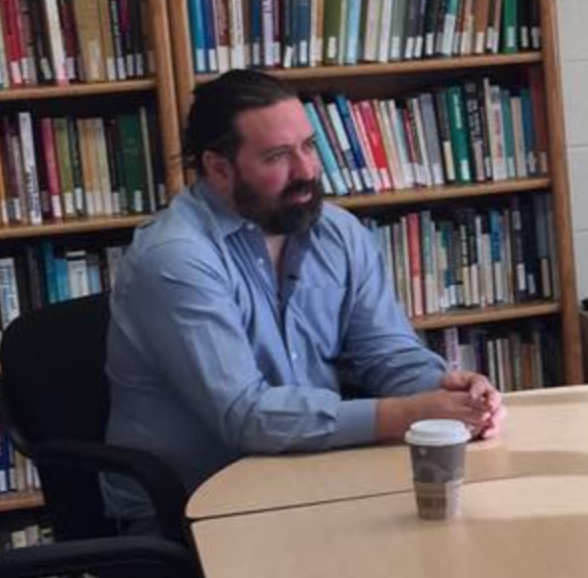
Workshop: Terrorism, Ticking Time-Bombs, and Torture

On February 11-12, we’re hosting an informal workshop at WMU to go through a draft of my book manuscript, Terrorism, Ticking Time-Bombs, and Torture (University of Chicago, forthcoming).  The full schedule is now available.  Registration is open to the public; please just send an email to the workshop organizer, Vishal Garg (vishal.k.garg@wmich.edu).  Any graduate students wanting to attend can ask Vishal for housing as well; we’re happy to get that worked out.

POSTED ON January 27, 2010

NSF Report on Nanotechnology and Human Enhancement

For the past three years, I’ve been working on a grant from the National Science Foundation with my colleagues Pat Lin, John Weckert, and Jim Moor.  The topic was ethical issues in nanotechnology and human enhancement, and we were trying to figure out how nanotechnology will come to bear on human enhancement and what the associative ethical issues are therein.  It’s been a great project and we’re very grateful to the NSF for their support.  The final report has just been published, and feedback is very welcome; we also put out a press release.  Also, see some of the other things we’re doing on the ethics of human enhancement.

Update:  Science and Engineering Ethics has just published an executive summary of the NSF report.

Update:  Studies in Ethics, Law, and Society has just published the entire report.  Please cite to this version.

POSTED ON January 25, 2010

Philosophies of the Sciences

I just got a copy today of my new edited book, Philosophies of the Sciences:  A Guide (Oxford:  Wiley-Blackwell, 2010).  This book started to develop at the same time I was working on Philosophy of Science:  An Historical Anthology (Oxford:  Wiley-Blackwell, 2009) with my colleagues Tim McGrew and Marc Alspector-Kelly.  In the collaborative book, I had the idea of adding some historical context for the so-called “special sciences”, including biology (Darwin), chemistry (Lavoisier), and geology (Cuvier and Lyell); we also included physics (Einstein).  But then I was thinking that there should be a whole book about philosophical issues in the difference sciences, particularly one that offered review essays and provided a starting point for further research; another goal would be to let discussions from different sciences land in the same venue and be able to inform each other.  From that, Philosophies of the Sciences was born!

The essayists did a fantastic job integrating disparate themes and vast literatures; I highly commend each essay.  After some introductory essays, the book is divided into three parts:  exact sciences (logic, math, and probability); natural sciences (physics, chemistry, biology, and earth science); and behavioral and social sciences (cognitive sciences, psychology, sociology, and economics).  It’s out in hardback for now, but a paperback will be on its way soon.  Check it out and let me know what you think!

POSTED ON January 12, 2010

Spring Courses

Our spring semester starts next week, and I have two courses being offered.  The first is one that I teach most years, biomedical ethics; it’s being taught online.  This one is a lot of fun, and the enrollment is strong, so I’m looking forward to it.  The second course is a senior seminar, and I really wondered what to focus on.  All our majors have to take this course, which is only offered once per year.  It’s hard to think of something that would appeal to a broad range of interests, but I picked “New Atheism”; it seems to me this integrates various themes from philosophy of religion, philosophy of science, metaphysics, epistemology, and ethics.  In other words, there should be something for everyone.  And, furthermore, I just wanted to read these books–  Harris, Hitchens, Dawkins, and Dennett–which have received so much attention.  It bears emphasis that the course is not a defense of any of these positions, but rather is meant to be an evaluation thereof.  Should be fun!

POSTED ON January 5, 2010